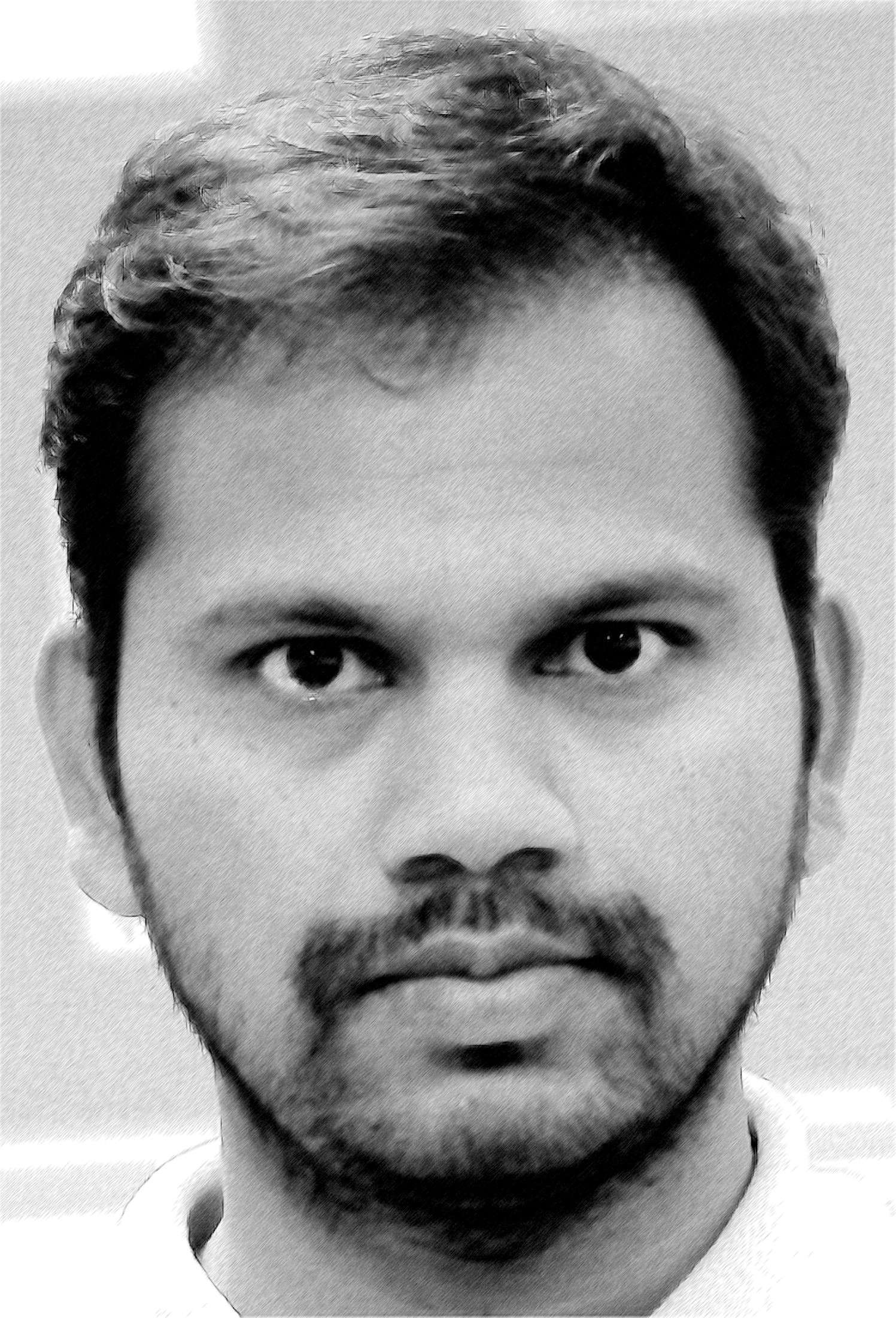
About the Researcher
Pattabhi Ramaiah

Pattabhi Ramaiah

Founder, BNPRS Private Limited · Research Analyst, IT Partners, Dubai, UAE

Pioneering research in biometrics, AI, and identity intelligence with over 16 years of experience in designing secure systems and large-scale deployments. Expertise spans artificial intelligence, machine learning, data science, biometrics (fingerprint, face, iris, voice, gait, DNA), document digitization (OCR), EMV technology, and forensic intelligence systems.

Education

2015

Post-Doctoral Research

The Hong Kong Polytechnic University

2015

Ph.D. in Computer Science & Engineering

IIT Hyderabad

2007

M.Tech. in Artificial Intelligence

University of Hyderabad

2004

B.Tech. in CS & IT

JNTU Hyderabad

Experience

Current

Research Analyst

IT Partners, Dubai, UAE

4G Identity Solutions

India

BioMoRF

Indonesia

Canny Quest International

Dubai, UAE

Recognition

IITH Academic Excellence Award

2012

ISBA2015 Doctoral Consortium

Hong Kong

JENESYS Program Delegate

Japan, 2012

Biometric Summer School

Italy, 2018

Major Projects

Aadhaar (UIDAI) NPR QiCard Indonesia NID (e-KTP)
Research Output

Our Publications

Peer-reviewed research contributions across biometrics, pattern recognition, and computer vision published in leading IEEE and Springer venues.

2017
Towards more accurate IRIS recognition using cross-spectral matching

Pattabhi Ramaiah N, Ajay Kumar

IEEE Transactions on Image Processing Vol. 26.1, pp. 208–221
Show Abstract

Iris recognition systems are increasingly deployed for large-scale applications such as national ID programs, which continue to acquire millions of iris images to establish identity among billions. However, with the availability of variety of iris sensors that are deployed for the iris imaging under different illumination/environment, significant performance degradation is expected while matching such iris images acquired under two different domains. This paper develops a domain adaptation framework to address this problem and introduces a new algorithm using Markov random fields model to significantly improve cross-domain iris recognition.

2017
Palmprint Recognition Based on Minutiae Quadruplets

Tirupathi Rao A, Pattabhi Ramaiah N, Krishna Mohan C

Springer Proceedings of International Conference on Computer Vision and Image Processing (CVIP) Vol. 2, pp. 117–126
Show Abstract

This paper presents a palmprint recognition method based on minutiae quadruplets, leveraging the unique ridge patterns of palmprints for person authentication. The proposed approach uses quadruplet-based feature descriptors that are both rotation and translation invariant for robust matching performance.

2016
Advancing cross-spectral IRIS recognition research using bi-spectral imaging

Pattabhi Ramaiah N, Ajay Kumar

Springer Machine Intelligence and Signal Processing Vol. 1, pp. 1–10
Show Abstract

This work advances cross-spectral iris recognition research by introducing a bi-spectral imaging system capable of simultaneously acquiring visible and near infrared iris images with pixel-to-pixel correspondences, enabling improved domain adaptation for iris matching across different spectral bands.

2016
On matching cross-spectral periocular images for accurate biometrics identification

Pattabhi Ramaiah N, Ajay Kumar

IEEE 8th International Conference on Biometrics Theory, Applications and Systems (BTAS) Niagara Falls, NY, USA, pp. 1–6
Show Abstract

Periocular recognition has gained significant importance with the increasing use of surgical masks. This paper proposes a new framework for accurately matching cross-spectral periocular images using Markov random fields and three patch local binary patterns. The matching accuracy can be further improved by incorporating real-valued features recovered from pixels in iris regions. Experimental results from IIITD IMP and PolyU databases achieve state-of-the-art performance for cross-spectral periocular recognition.

2015
Sparsity-based iris classification using IRIS fiber structures

Pattabhi Ramaiah N, Srilatha N, Krishna Mohan C

IEEE 14th International Conference on Biometrics Special Interest Group (BIOSIG) Darmstadt, Germany, pp. 1–4
Show Abstract

As there is a growing demand for biometrics usage in e-Society, the biometric recognition system faces the scalability issue as the number of people to be enrolled runs into billions. This paper proposes an approach for iris classification using three different iris classes based on iris fiber structures — stream, flower, jewel and shaker — for faster retrieval of identities in large scale biometric systems. A sparsity based on-line dictionary learning algorithm is used with log-Gabor wavelet features.

2015
Illumination invariant face recognition using convolutional neural networks

Pattabhi Ramaiah N, Earnest Paul I, Krishna Mohan C

IEEE International Conference on Signal Processing, Informatics, Communication and Energy Systems (SPICES) Trivandrum, Kerala, India, pp. 1–4
Show Abstract

Face is one of the most widely used biometric in security systems. Despite its wide usage, face recognition is not a fully solved problem due to challenges with varying illumination and pose. This paper addresses face recognition under non-uniform illumination using deep convolutional neural networks. The symmetry of facial information is exploited to improve performance by considering horizontal reflections of facial images. Experiments on Yale facial image dataset demonstrate the efficacy of the approach.

2015
IRIS classification based on sparse representations using on-line dictionary learning for large-scale deduplication applications

Pattabhi Ramaiah N, Krishna Mohan C

SpringerPlus Vol. 4.1, p. 238
Show Abstract

De-duplication of biometrics is not scalable when the number of people to be enrolled runs into billions. This paper proposes iris classification based on sparse representation of log-gabor wavelet features using on-line dictionary learning for large-scale de-duplication applications. Three iris classes based on fiber structures — stream, flower, jewel and shaker — are used for faster retrieval. An iris adjudication process is illustrated using color coding to reduce identification errors.

2015
Nearest Neighbour Minutiae Quadruplets Based Fingerprint Matching with Reduced Time and Space Complexity

Tirupathi Rao A, Pattabhi Ramaiah N, Raghavendra V, Krishna Mohan C

IEEE 14th International Conference on Machine Learning and Applications (ICMLA) Miami, Florida, USA, pp. 378–381
Show Abstract

Large volumes of fingerprint data may lead to scalability issues regarding memory and computational complexity. This paper develops an efficient fingerprint matching algorithm using nearest neighbor minutia quadruplets (NNMQ). These minutia quadruplets are both rotation and translation invariant. Experimental results demonstrate reduced space and time complexities with standard fingerprint benchmark databases FVC ongoing, FVC2000 and FVC2004.

2014
Enhancements to latent fingerprints in forensic applications

Pattabhi Ramaiah N, Tirupathi Rao A, Krishna Mohan C

IEEE 19th International Conference on Digital Signal Processing (DSP) Hong Kong, China, pp. 439–443
Show Abstract

Latent fingerprint identification is a challenging task in criminal investigation due to poor quality ridge impressions and limited region of interest. This paper proposes a semi-automated latent fingerprint identification system using image enhancement filters to improve identification performance. The system uses global and local adaptive binarization along with minutia features conforming to ISO/IEC 19794-2 standard. Efficacy is demonstrated on the standard NIST SD-27 latent prints database.

2011
De-duplication of photograph images using histogram refinement

Pattabhi Ramaiah N, Krishna Mohan C

IEEE International Conference on Recent Advances in Intelligent Computational Systems (RAICS) Trivandrum, Kerala, India, pp. 391–395
Show Abstract

Content based image retrieval (CBIR) uses color, texture and shape to search images from large scale databases. This paper implements de-duplication of photographs using CBIR with color histogram refinement. Photograph data was divided into clusters using k-means clustering. The de-duplication exercise was carried out on a database of approximately 22 million photographs, identifying approximately 0.35 million duplicate photographs.

2011
De-noising slap fingerprint images for accurate slap fingerprint segmentation

Pattabhi Ramaiah N, Krishna Mohan C

IEEE 10th International Conference on Machine Learning and Applications and Workshops (ICMLA) Honolulu, Hawaii, USA, pp. 208–211
Show Abstract

Fingerprint images can have noisy data while capturing them using slap fingerprint scanners, causing improper segmentation and decreased matching performance. This paper removes noise from slap fingerprint data using binarization and region labeling with 8-adjacency neighborhood for accurate segmentation. Experimental results demonstrate that fingerprint segmentation rate improved from 78% to 99%.

2011
ROI-based tissue type extraction and volume estimation in 3D brain anatomy

Pattabhi Ramaiah N, Krishna Mohan C

IEEE International Conference on Image Information Processing (ICIIP) Waknaghat, Near Shimla, India, pp. 1–5
Show Abstract

ROI-based extraction and volume estimation of brain tissue types has gained attention from medical and computational research. In diagnosing diseases, the volume of a specific brain region needs to be estimated accurately. This paper proposes a pipelining process for normalization, ROI mask generation, segmentation and volume estimation using VBM5 and itk-SnAP tools, extracting grey matter, white matter, and cerebro-spinal fluid volumes automatically.